Cross-check any supplier
against the registers.

Proof, not promises — every line sourced and dated.

A supplier’s desk — a buyer enquiry on the laptop, product catalogue, certificates and compliance documents, the verifiable ones highlighted

The quote is the easy part.
The hard part is the meeting where you explain why you took it.

The cheaper quote is not the risk. Having to make the case for it alone is.

You are rarely the only signature. Quality wants to know whether the goods can legally land. Finance wants to know who is liable if they cannot. Your director asks the one question that outranks all of it: what happens to us if you are wrong.

None of that is settled by feeling good about the supplier. It is settled by a record — the one you would have pulled in an afternoon if the factory were down the road.

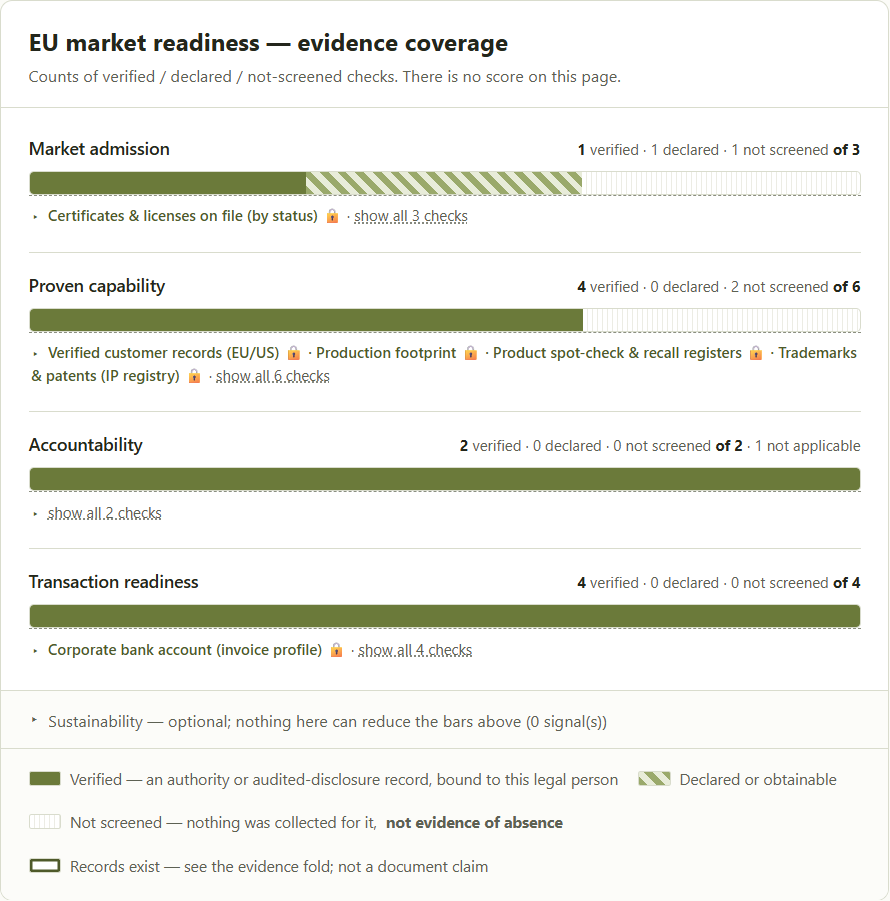
The evidence-coverage panel: five bars counting verified, declared and not-screened checks, with the line "There is no score on this page."

Most factories are not rejected.
They are simply too hard to judge.

A supplier in China sends over a folder: company profile, certificates as PDFs, a few photos of the line. It all fits together, and most of it is accurate. It also all comes from one side of the table.

With a supplier down the road you would barely notice the next step. The register is one click away, and the folder either agrees with it or it does not.

Sourcing from China, that step quietly goes missing. There is no practical way, inside a sourcing timeline, to hold that folder next to the official record and confirm the two agree.

So the file sits in the inbox, and the decision waits — not because anything is wrong, but because nothing can be checked.

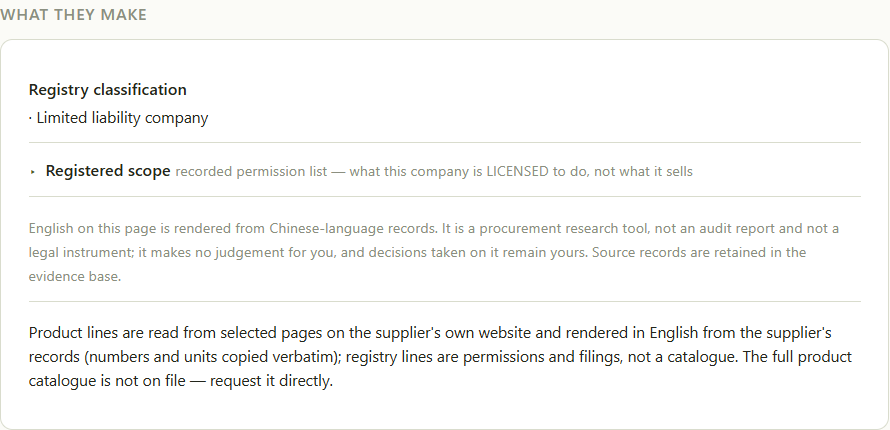
The "What they make" block: the registry classification and licensed scope, with anything the supplier says about itself labelled as self-reported.

Check a supplier in Wuxi
the way you’d check one in Wuppertal.

At home, pulling the register is a reflex. Eight thousand kilometres away that reflex dies, and the check ends where Google ends. This page is that reflex, given back.

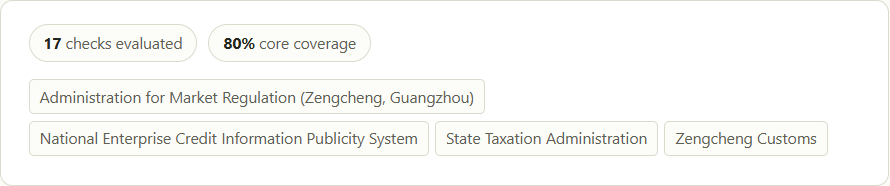
Provenance chips: 17 checks evaluated, 80% core coverage, and the recording authorities named — Administration for Market Regulation, National Enterprise Credit Information Publicity System, State Taxation Administration, Zengcheng Customs.

Every report ends in a line we are prepared to defend.

Verified manufacturer
a production site, bound to its discharge permit
Registered manufacturer
a production site on the register, permit not bound
Verified exporter
registered with customs as an exporter
Registered supplier
on the register, and nothing further yet
Identity on file
we could bind the identity, and no more

Not a score. Not a ranking. A tier — with the reason attached, and the gap note that comes with it.

The verdict line "Verified manufacturer" with the note "EU documentation incomplete · core coverage 80%", beside four standing lamps — two of them locked until the deep check.

Six questions you will be asked.
Six things you will have.

One supplier, one page, in English — every line naming the authority and the date.

01
Who am I actually talking to?
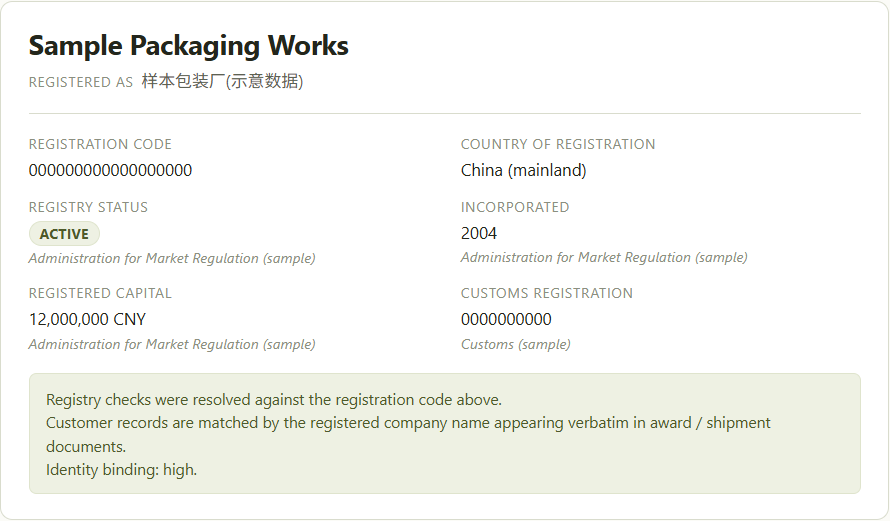
You have the legal person behind the trading name, bound to its credit code — Identity binding: high — with its registered name in Chinese beside the English one, and the registered address on the map.
Administration for Market Regulation · read on the date printed on the line
A supplier identity card: English name, the registered Chinese name beside it, registration code, registry status, incorporation year, capital and customs registration — each line naming the authority that recorded it.
02
Any live landmines?
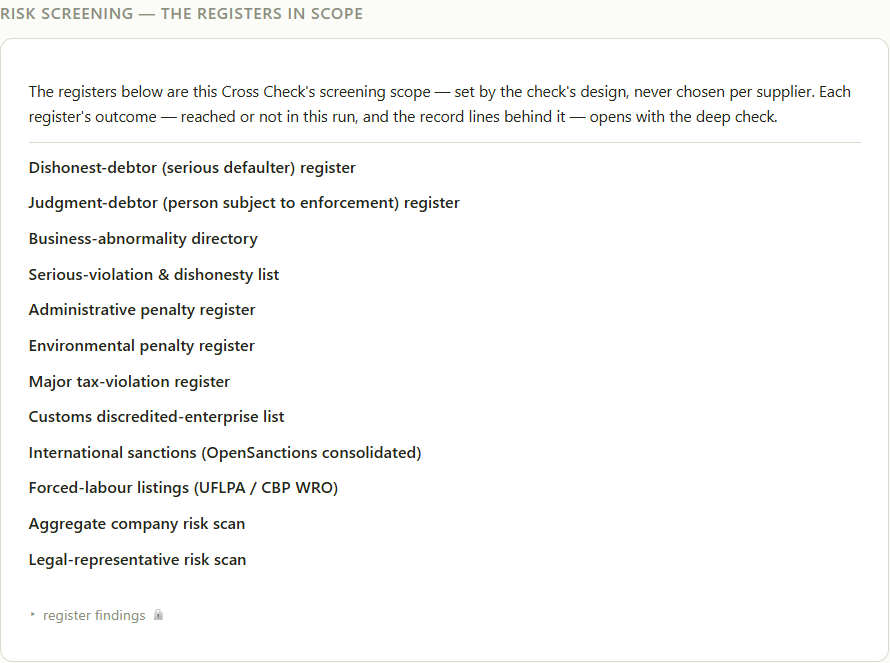
You have the screening scope in writing: the dishonest-debtor register, the judgment-debtor register, business-abnormality, serious-violation, administrative and environmental penalties, tax violations, customs discredit, international sanctions, forced-labour listings. Named up front, chosen by the check, never per supplier. A blank says not screened. It never says clean.
Each register named on its own line, with what it returned
The risk-screening scope: twelve registers named in full, from the dishonest-debtor register to forced-labour listings, above the line "set by the check’s design, never chosen per supplier".
03
Can their products legally enter the EU — and stay on the shelf?
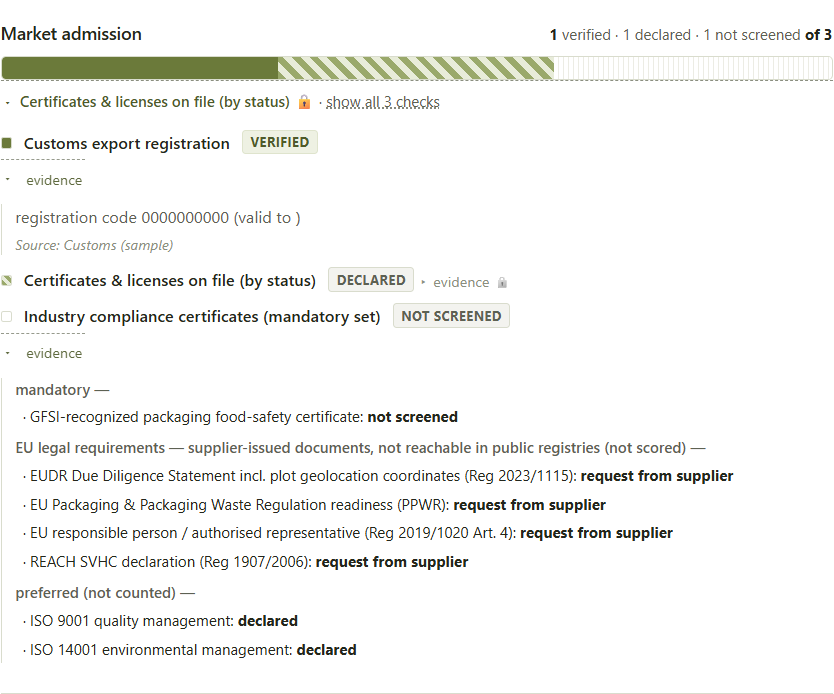
You have each certificate number checked against the register that issued it, and the status as it reads there on the day it was read. Where a certificate should exist and does not, the line says not screened, not “none”.
The issuing register, named · the date it was read
Market admission: customs export registration verified, certificates on file declared, and the mandatory industry set marked not screened — each certificate scheme listed with its own status.
04
Who has actually bought from them? Is quality stable?
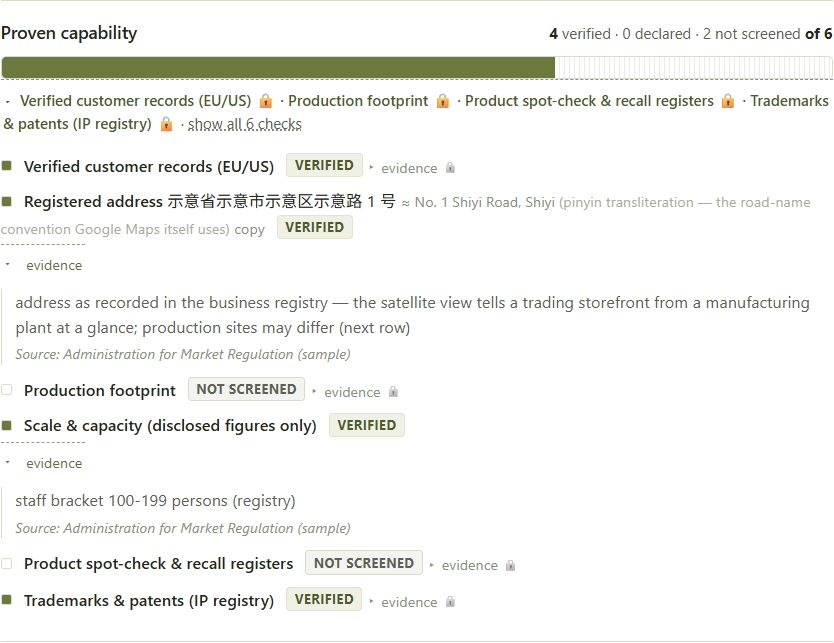
You have the U.S. customs bills of lading — who really shipped, not who was named as a reference. And you have the national spot-check and recall registers, both outcomes, with the window they cover.
U.S. customs import records · State recall registry · SAMR supervision registry
Proven capability: customer records, registered address with satellite view, production footprint, disclosed scale, and the spot-check and recall registers — each with its own status.
05
If something goes wrong, whom do I hold? Can they disappear?
The website says five hundred people. You have the number on the social-insurance record. You have whether the legal person is still active and since when, the group it sits inside, and the branches attached to it.
Social-insurance fields, verbatim · National Enterprise Credit Information Publicity System
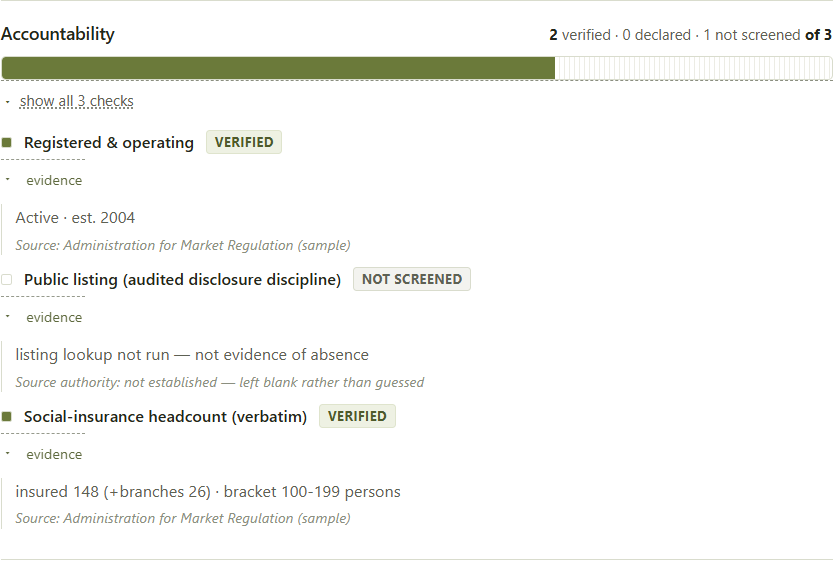
Accountability: registered and operating since 2004, a public-listing lookup marked not screened with the note that nothing was run is not evidence of absence, and the social-insurance headcount — insured 148 plus 26 in branches, bracket 100-199 persons.
06
Is doing business with them smooth?
You have their customs credit tier and what it buys them at clearance, their tax credit grade and how many years it has held, and the year they were first registered to export.
Customs · State Taxation Administration · IEC filing date
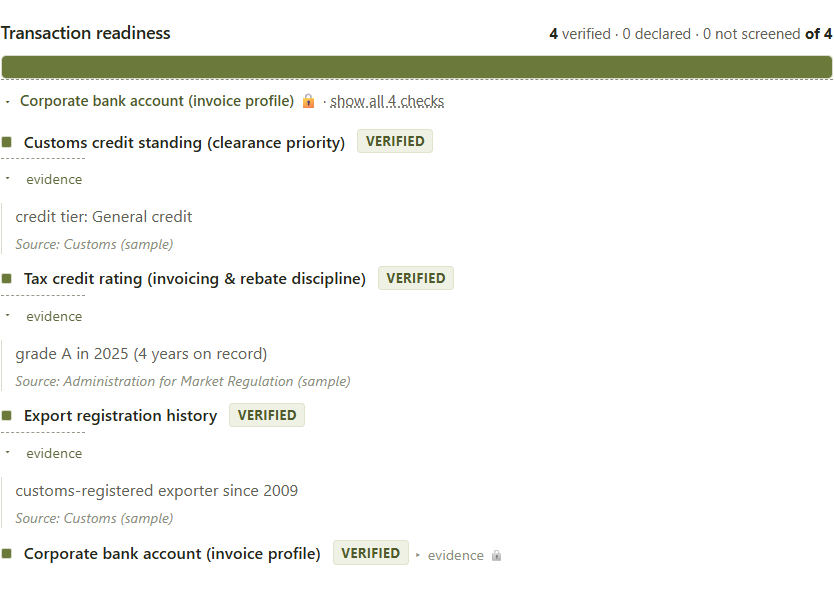
Transaction readiness: customs credit tier, tax credit grade A with four years on record, and customs-registered exporter since 2009.

A trading storefront and a manufacturing plant
look nothing alike from above.

What this page will not do.

Built only from public records and the supplier’s own published statements.

It does not score suppliers, and it does not rank them.
A register does not pass judgement. It lets you look things up.
A blank says “not screened”. It never says “clean”.
“We did not check this” and “we checked this and it is fine” lead to two different decisions, and only one of them is safe to make on a blank.
A short bar means documents are missing — never that the company is weak.
A newly registered workshop with clean lamps gets the same green lamps as a listed group, with shorter bars.
The legend: verified means an authority record bound to this legal person; not screened means nothing was collected for it — not evidence of absence.
Is this supplier FSC & compostable certified?

Cross-check your next supplier.

Proof, not promises — every line sourced and dated, before the first email.

Look up a supplier